
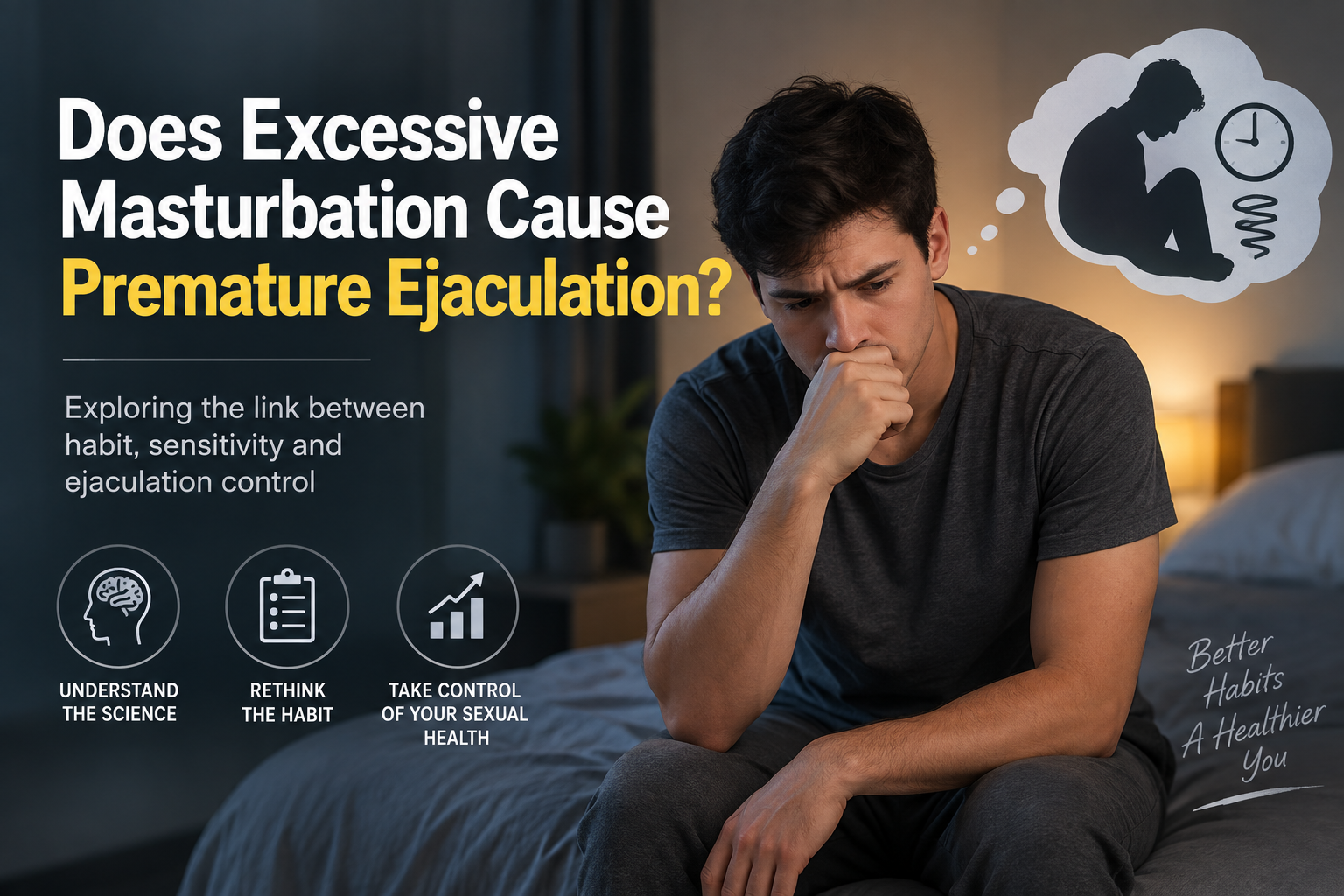
If you already have “Premature Ejaculation”, don’t walk away believing you permanently destroyed your body years ago. Current evidence doesn’t support that conclusion.
You Used to Last Longer. So What Changed?
A few years ago, pleasure felt different. You had time. Control. Now you barely get started before it’s over.
You haven’t changed partners. You haven’t changed your health, at least not obviously. So what actually changed?
Here’s a possibility you may not have considered: you’ve been masturbating in the same way, probably since your teenage years, thousands of times over. Could the way you’ve been doing it matter, not just the fact that you do it?
Let’s investigate.
Nothing Else Seems to Fit
When ejaculation control changes, most men mentally scan the obvious causes first. Stress. A new relationship. Anxiety. Maybe an underlying health issue, an infection, a medication, or erectile difficulty that’s making you rush.
Those are all real, valid possibilities, and ruling them out matters. But sometimes there’s no clear trigger. No trauma. No new diagnosis. Just a habit you’ve repeated for years.
That’s worth a second look.
The One Constant: Your Masturbation Pattern
Masturbation itself isn’t the issue here. It’s normal, common, and healthy. But masturbation technique varies enormously between men, and that variation rarely gets discussed.
Some habits that may matter more than people realize include excessive friction, a very tight grip, extremely fast stimulation, repeatedly focusing on one small area, and always rushing toward climax as quickly as possible.
Could the way you’ve been stimulating yourself matter as much as how often? That’s the real question. First, let’s define the problem properly.
What Exactly Is Premature Ejaculation?
Premature ejaculation, or PE, isn’t just “finishing fast.” Doctors also look at control, distress, and whether the pattern is consistent and troubling for the person experiencing it.
There’s an important distinction here. Lifelong PE means rapid ejaculation has been present since a man’s very first sexual experiences. Acquired PE means control used to be normal, but declined later. If you’re someone saying “I didn’t always have this problem,” you fall into the second group, and that raises different questions than lifelong PE does.
The Missing Piece: Penile Sensitivity
Stimulation activates sensory nerves in the penis. These nerves send signals up through the spinal cord, eventually triggering the ejaculatory reflex.
Normal sensitivity is essential. Without it, sexual function wouldn’t work at all. Hypersensitivity is different, a heightened, faster-than-average sensory response that researchers believe may play a role in some cases of PE.
The Glans and Shaft Aren’t the Same Sensory Surface
If you’ve already convinced yourself you know exactly where the “damage” is, or that one specific spot has become too sensitive from years of habit, you might have it wrong. Sensitivity in the penis isn’t as simple as “the part I touch most is the part that’s affected.” Here’s what the anatomy actually shows.
The glans and the shaft differ in structure and nerve supply. A 2023 study in Asian Journal of Andrology, led by Zheng and colleagues, measured sensory responses separately in each region among 290 men with primary PE, using a technique called somatosensory evoked potentials (SSEPs).
The results showed clear differences between the glans and shaft. This led the researchers to propose a “penile hypersensitive zone”, the idea that hypersensitivity can be localized to one region, rather than affecting the whole organ equally.
What the Research Actually Found
Here are the real numbers. Among the 290 men studied, 141 (48.6%) showed hypersensitivity in the glans, the shaft, or both.
Within that hypersensitive group:
- 77 men (54.6%) had shaft-only hypersensitivity
- 50 men (35.5%) had both glans and shaft hypersensitivity
- 14 men (9.9%) had glans-only hypersensitivity
This tells us hypersensitivity shows up in close to half of men with primary PE in this study. It does not tell us that hypersensitivity causes every case of PE, or that the glans is automatically the main problem. Notice the shaft was actually the most commonly affected region alone.
Now Back to the Habit: What About Years of High-Friction Masturbation?
It’s a reasonable instinct to wonder whether repeatedly applying intense friction to a small area of tissue could change how that area responds over time. Genital sensory physiology, though, is far more complex than simple skin irritation.
The real scientific question is this: could years of intense, repetitive, highly localized masturbation influence penile sensory responses, learned arousal patterns, or ejaculation control? That’s a plausible hypothesis.
Here’s the Good News: The Evidence for Permanent Damage Just Isn’t There
This part matters most, so let’s be direct, and reassuring.
Research shows that sensory differences and hypersensitivity are associated with at least some cases of PE. But there’s very little evidence supporting the chain many men quietly fear: that aggressive masturbation damages the glans, which creates permanent hypersensitivity, which causes PE for life.
That’s genuinely good news. Whatever pattern you’ve repeated for years isn’t automatically locked in as a life sentence.
The Zheng study looked at men who already had PE and measured their sensory responses at that point. It didn’t track teenagers over years, and it didn’t test whether specific masturbation techniques caused the hypersensitivity researchers observed. The masturbation-to-hypersensitivity pathway remains an interesting, testable hypothesis, not established medical fact, and certainly not a proven permanent condition.
Repeated patterns can potentially shape sexual conditioning over time. That doesn’t mean premanent damage. It means habit. Pay attention to the pattern you’re training.
For Younger Readers: Don’t Wait for a Problem to Change a Rough Habit
This isn’t about fearing masturbation or your own body. It’s about avoiding unnecessary intensity.
Sensible habits include using adequate lubrication, avoiding painful or forceful friction, not concentrating extreme stimulation on one small area, and above all the frequency of doing it. If soreness, numbness, or broken skin shows up, stop and let your body recover, and see a doctor if symptoms persist.
One more thing: don’t just move aggressive stimulation from the glans to the shaft. Remember, the shaft was actually the most commonly hypersensitive region in the study above. Reduce the friction, don’t relocate it.
Medical disclaimer: This article is for general educational purposes only and does not constitute medical advice, diagnosis, or treatment. If you’re experiencing persistent or distressing changes in ejaculatory control, please consult a licensed physician, urologist, or sexual health specialist.
Leave a Reply