

Delay sprays are one of the most common of the self-treatments for premature ejaculation, which simply contains some local anaesthetic, normally a mix of lidocaine, prilocaine or a blend of both, that desensitizes the penis for a brief period. The body does not reach a point of ejaculation until there is less sensation.
That sounds like a practical solution to men who are plagued by premature ejaculation. For many, indeed, it is. However, a question is repeatedly asked and deserves a proper answer: can you cause lasting damage if you use a numbing spray regularly over a period of months or years?
In this article, I examine what the evidence actually does reveal, and then pose a question that is often overlooked.
Why Delay Sprays Exist
Ejaculation is largely a reflex. As arousal builds, sensory nerves in the penis, particularly around the glans, send signals to the spinal cord and brain. Once these signals reach the ejaculatory threshold, the reflex is triggered and the process becomes mostly automatic.
Some research suggests that men with premature ejaculation (PE) may have greater glans sensitivity or differences in the nerve pathways involved in ejaculation. This helps explain the idea behind delay sprays: if sensory input from the glans is reduced, the build-up toward the ejaculatory threshold may take longer, potentially delaying ejaculation.
But there is a prior question that rarely gets asked:
Why does a man feel he needs to repeatedly numb penile sensation in the first place?
A delay spray manages a symptom. It does not investigate the cause. If a man finds himself needing more product, more often, to achieve the same result, the useful response may not be to worry about tissue damage, it may be to ask what is driving the ejaculatory difficulty.
So for that it is essential to distinguish between the two types of PE:
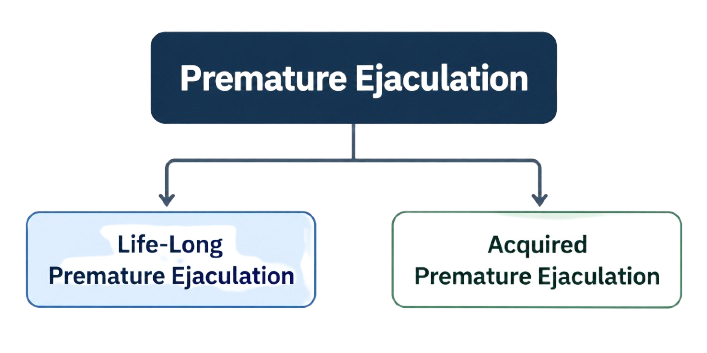
Lifelong PE
Present from a man’s first sexual experiences and with a fixed short ejaculatory latency. Current theories include a neurobiological and/or possibly genetic component, such as differences in serotonin signalling and/or reflex pathways. Topicals (Fortacin) have a specific licence for primary (lifelong) PE.
Fortacin is a lidocaine/prilocaine spray that is sprayed directly onto the glans just before penetration. It can reduce the sensation from the glans to help the man avoid reaching the ejaculatory threshold mentioned above, but without having to take medicine throughout the body.
Acquired PE
Develops after a period of previously normal ejaculatory function. This is the form most likely to have an identifiable, treatable cause. Factors associated with the causes include:
- Erectile dysfunction: men who struggle to maintain an erection may unconsciously rush toward ejaculation.
- Habitual high-friction, glans-focused masturbation: Repeated intense pressure on the glans may alter how some men respond to stimulation, potentially affecting sexual sensation and ejaculatory control. This is discussed clinically but has not been confirmed in controlled research.
- Thyroid dysfunction, particularly hyperthyroidism.
- Psychological factors, especially performance anxiety, relationship stress, or a period of sexual difficulty that becomes self-reinforcing.
Understanding why a man might need this kind of help is one thing, knowing what the spray actually does to the body, and whether it delivers on that promise in practice, is another. The sections that follow walk through both: how the numbing effect is produced, and what the clinical evidence says about how well it actually works.
How Does a Delay Spray Work?
Lidocaine and prilocaine temporarily reduce sensory signals from the glans, creating partial rather than complete numbness. This controlled desensitization can slow the build-up toward ejaculation while preserving sexual sensation, as illustrated by the two pathways below:
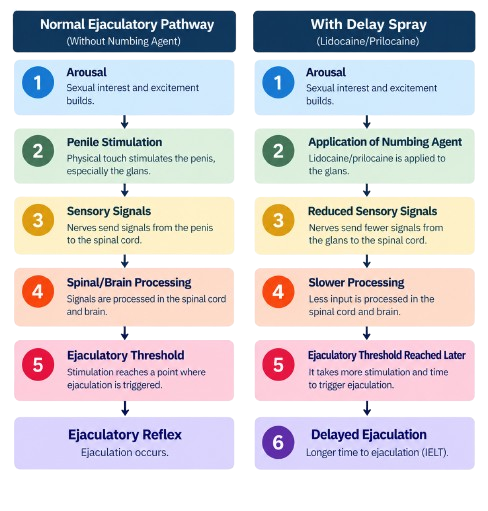
What has changed here is not desire, not erection, and not the reflex itself, only the rate at which sensory input reaches the nervous system. The container fills more slowly, so it takes longer to overflow.
How Effective Are Delay Sprays?
There is reasonably good clinical data for lidocaine / prilocaine spray.
Geometric mean intravaginal ejaculatory latency time (IELT — the time from penetration to ejaculation) increased from a baseline of 0.6 minutes to 3.8 minutes with active treatment versus 1.1 minutes with placebo in a phase III, multicentre, double-blind, placebo-controlled study in 300 men with PE. This was a 6.3-fold increase compared to 1.7-fold in those who took the placebo.
The stopwatch wasn’t the only part that was improved. Men who were active treatment reported significantly larger improvements in the Index of Premature Ejaculation than did those taking placebo.
However, when it comes to the adverse effects of numbing agents there are a few that grabs the attention of the users.
What About Tolerance?
Tachyphylaxis refers to the decreased effectiveness of a drug after administration of the same drug more than once. Researchers found that lidocaine/prilocaine sprays remained effective when used at the recommended dose. But sustained activity cannot be assumed to be safe or without possible effects on sensation, tissue or fertility.
Even at approved doses, side effects occur.
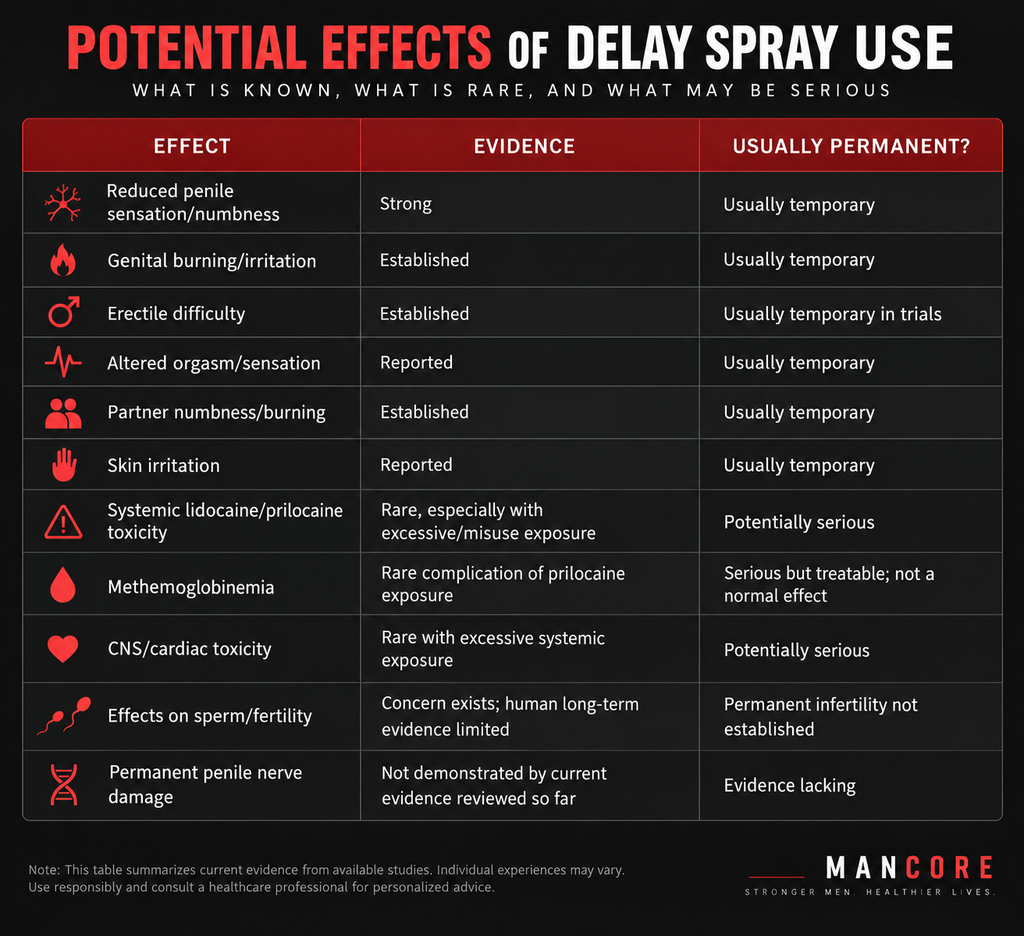
Across clinical trials, adverse reactions were reported in 9.6% of male users and 6.0% of female partners. Most cases were mild to moderate. Notably, a higher rate of erectile dysfunction and genital hypoaesthesia has been reported when the spray is used together with male condoms, likely because the product remains in contact with the skin rather than being wiped away.
Additionally, the following table will enable you to gauge the level of impact (chronic or acute) you can expect with supporting evidence:
A Proposed Pathway Worth Considering
Our previous article examined whether aggressive, high-friction, glans-focused masturbation might contribute to altered sensitivity and acquired ejaculatory difficulty in some men.
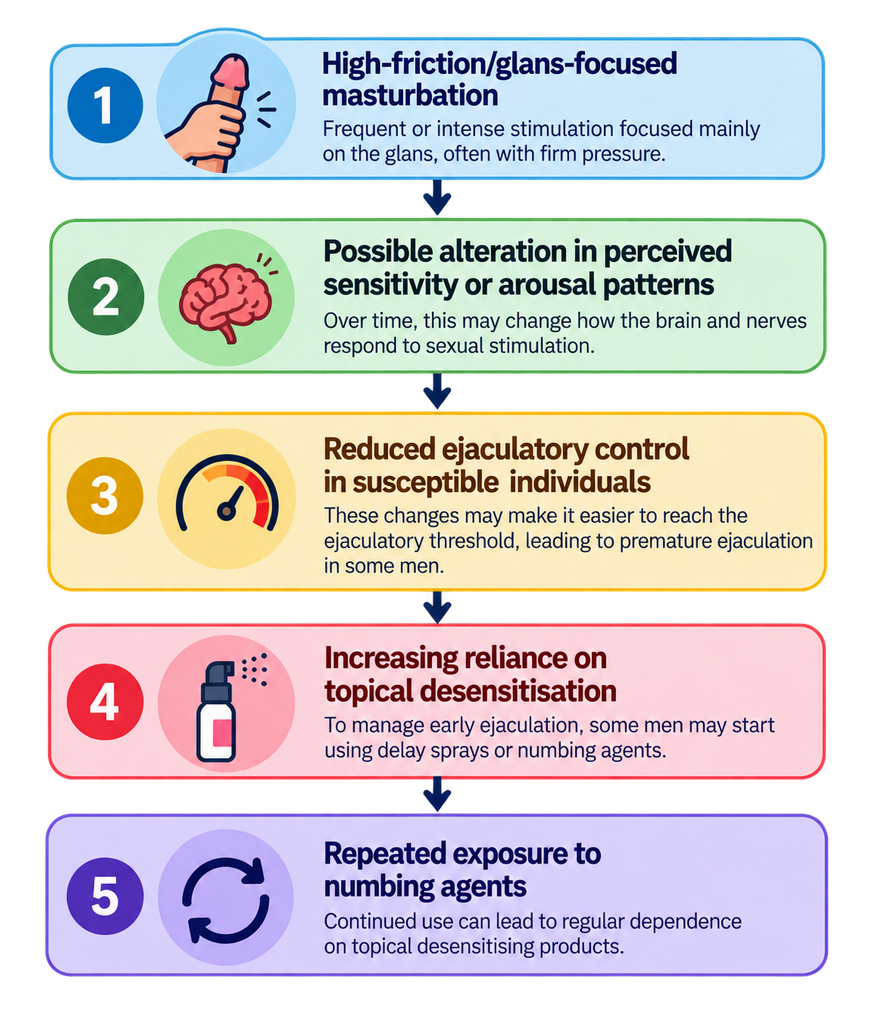
This remains a proposed pathway. Masturbation itself is not a health hazard, what this hypothesis actually concerns is a common technique: habitual high-friction, glans-focused stimulation, which many men adopt without realising it feels different from partnered sex.
Final Verdict: Can Excessive Delay-Spray Use Permanently Damage the Penis?
In a trial of 596 men, documented effects — hypoaesthesia, erectile dysfunction, burning, irritation, and partner transfer — were mostly mild to moderate, with low discontinuation rates.
However, repeatedly numbing penile sensation may manage a symptom without explaining why premature ejaculation is occurring. For persistent or newly acquired PE, identifying and addressing an underlying medical, sexual or psychological contributor may provide a more appropriate long-term strategy than increasing reliance on topical desensitisation.
For further details on usage of numbing agents please refer to:
https://www.drvijayantgovinda.com/2025/02/09/delay-spray-benefits-risks-and-proper-usage/
This article is for general information and does not replace individual medical assessment. Persistent premature ejaculation, erectile difficulties, changes in genital sensation, genital pain, or concerns about fertility should be evaluated by a qualified healthcare professional, such as a GP, urologist or sexual health specialist.
Sources:
https://www.ema.europa.eu/en/medicines/human/EPAR/fortacin
https://bjui-journals.onlinelibrary.wiley.com/doi/10.1111/j.1464-410X.2009.08456.x
Leave a Reply