
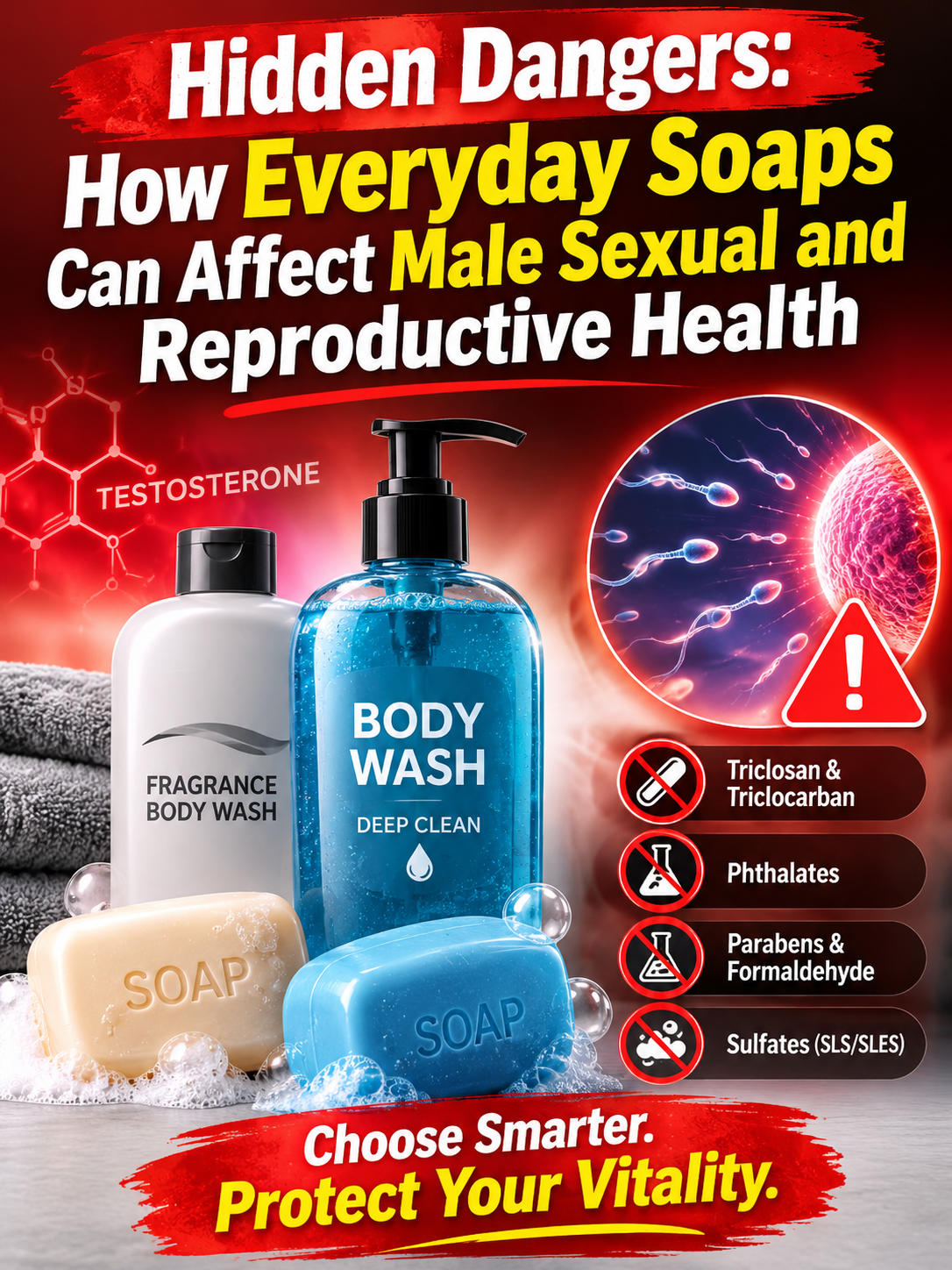
Hidden Dangers: How Everyday Soaps Can Affect Male Sexual and Reproductive Health
Your daily soap may be doing more than cleaning your skin. Some commonly used personal-care ingredients have attracted scientific attention because of their potential to interfere with hormonal signalling, reproductive development and the body’s natural protective barriers.
For men, this deserves attention. Hormonal balance, sperm health, reproductive function and sexual well-being are all important aspects of male vitality. Yet many men choose their soaps based on fragrance, foam, price or marketing without looking closely at the ingredients.
Certain antibacterial agents, fragrance-related chemicals, preservatives and harsh cleansing substances deserve particular scrutiny. Understanding what they are, where they appear and why they matter can help men make more informed grooming decisions.
1. Antibacterial Soaps: Triclosan and Triclocarban
BODY WASH
Antibacterial soaps are often marketed as a superior way to eliminate germs. However, some formulations have historically contained chemicals such as triclosan (TCS) and triclocarban (TCC), which have attracted attention because of their potential endocrine-disrupting properties.
The endocrine system regulates essential bodily functions, including testosterone production and reproductive development. Experimental research has raised concerns about how exposure to these compounds may influence hormone-related pathways.
Why should men pay attention?
- Hormonal signalling: Experimental research has identified potential interactions with pathways involved in hormone regulation.
- Reproductive development: Animal and laboratory studies have raised questions about possible reproductive effects.
- Unnecessary exposure: Routine washing generally does not require specialised antibacterial body washes.
What to look for: Check product labels for triclosan and triclocarban. For everyday hygiene, a conventional gentle cleanser is a more sensible choice than relying on antibacterial marketing.
2. Heavily Fragranced Soaps: Phthalates and Fragrance Chemicals
SCENTED BODY WASH
A strong fragrance may make a soap appealing, but the ingredients behind that fragrance deserve attention.
Phthalates are a family of chemicals used in various industrial and consumer applications. Certain members have demonstrated endocrine-related effects in experimental research, including interference with androgen-related activity.
Androgens, including testosterone, play important roles in male reproductive development and function. This is why researchers have investigated relationships between phthalate exposure and male reproductive health.
Potential areas of concern include:
- Hormonal disruption: Certain phthalates have demonstrated anti-androgenic activity in experimental studies.
- Sperm health: Human research has examined associations between phthalate exposure and semen-related measures.
- Repeated exposure: Fragranced personal-care products can contribute to a person’s overall exposure to fragrance-related chemicals.
On ingredient labels, fragrance may appear as “fragrance” or “parfum.” These terms do not disclose every individual component of a fragrance mixture.
What to look for: Consider fragrance-free products, particularly if you use body wash frequently or experience irritation. Do not assume that a product is harmless simply because it smells pleasant or is marketed as natural.
3. Preservative-Containing Soaps: Parabens and Formaldehyde-Releasing Ingredients
LIQUID CLEANSER
Preservatives help prevent microbial contamination and extend the shelf life of personal-care products. However, some preservative ingredients have also attracted attention because of their biological activity.
Parabens, including methylparaben, propylparaben and butylparaben, are used in certain cosmetic formulations. Some have demonstrated weak estrogen-like activity in laboratory studies.
This matters because male reproductive function depends on a carefully regulated hormonal environment.
Researchers have investigated possible relationships between paraben exposure and:
- Hormonal balance: Certain parabens can interact with estrogen-related pathways in experimental settings.
- Reproductive measures: Studies have examined associations with semen quality and hormone-related measurements.
- Skin sensitivity: Some preservatives, including certain formaldehyde-releasing ingredients, can trigger contact irritation or allergic reactions in susceptible individuals.
The concern is not simply about one ingredient in isolation. It is also about the range of personal-care products people may use repeatedly over time.
What to look for: Check labels for methylparaben, propylparaben and other parabens if you prefer to avoid them. If a product repeatedly causes irritation, discontinue its use and consider a simpler alternative.
4. Harsh Detergent Soaps: SLS and SLES
BODY CLEANSER
Sodium lauryl sulfate (SLS) and sodium laureth sulfate (SLES) are cleansing agents commonly used to create foam and remove oils.
Their main concern in personal hygiene is their potential to irritate the skin, particularly when formulations are harsh or washing is excessive.
This is especially relevant to the genital area, where the skin can be sensitive.
Repeated exposure to irritating cleansers may contribute to:
- Dryness and irritation: Strong cleansing agents can remove natural surface oils and disturb the skin barrier.
- Redness and burning: Sensitive genital skin may react to harsh formulations.
- Itching and discomfort: Repeated irritation can make everyday hygiene uncomfortable.
- Inflammation: Irritation can contribute to symptoms affecting the glans or foreskin, although infections and other skin conditions can also cause inflammation.
These effects matter because genital comfort and healthy skin are important parts of sexual well-being.
What to look for: Avoid aggressive scrubbing and excessively harsh cleansers. Wash the external genital area gently with lukewarm water. If you use a cleanser, choose a mild, fragrance-free option and rinse thoroughly. Never apply body wash inside the urethral opening.
Grooming Checklist: Make Better Choices for Male Health
Your grooming routine should support cleanliness without exposing sensitive skin to unnecessary irritants.
Choose Gentle, Simple Care
- Prefer fragrance-free products: Particularly if you have sensitive skin or experience recurring irritation.
- Check antibacterial ingredients: Look for triclosan and triclocarban.
- Pay attention to preservatives: Check for parabens if you prefer to avoid them.
- Avoid unnecessarily harsh cleansers: Consider mild products rather than aggressive, high-foaming formulations.
- Do not over-wash: Frequent washing and aggressive scrubbing can worsen skin irritation.
- Listen to your skin: Stop using products that repeatedly cause burning, itching, redness or dryness.
A product does not become healthier simply because it promises stronger cleaning, longer-lasting fragrance or more foam.
When to Get Medical Advice
Persistent genital redness, swelling, pain, discharge, sores or burning should not be ignored. These symptoms can have several causes, including infections and skin conditions, and deserve medical assessment.
Similarly, concerns about testosterone, libido, erectile function or fertility should be evaluated by a qualified healthcare professional rather than attributed to a particular soap without investigation.
The Bottom Line
Men often pay attention to their diet, exercise routines and supplements when thinking about vitality, but personal-care products deserve attention too.
Ingredients such as triclosan, triclocarban, certain phthalates and parabens have attracted scientific scrutiny because of their potential hormonal and reproductive effects. Meanwhile, harsh cleansing agents and heavily fragranced products can create practical problems for sensitive genital skin.
Your daily grooming routine should not be an overlooked source of unnecessary exposure or irritation.
Read the ingredient label. Choose your products carefully. Protect your skin and take your reproductive health seriously.
Medical disclaimer: This article is for educational purposes and does not replace professional medical advice, diagnosis or treatment. Research findings on individual ingredients should not be interpreted as proof that a particular soap causes infertility, low testosterone or erectile dysfunction.
Leave a Reply