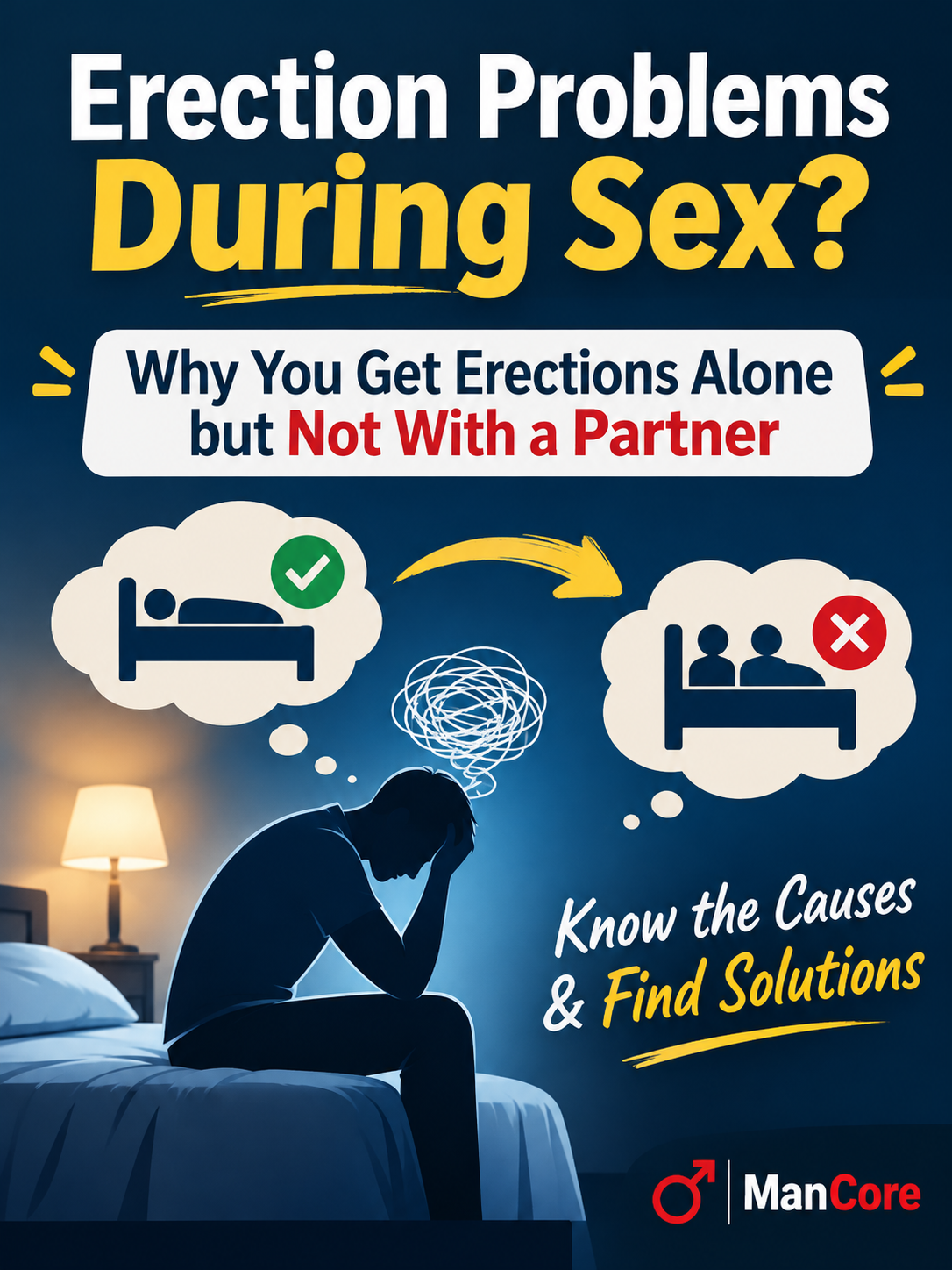
A 5-minute read on why erections can show up alone but fade with a partner
Start here: five things worth knowing
- You are not automatically impotent because this happened during intimacy.
- You may have no previous history of erectile dysfunction.
- You may get morning, spontaneous, or solo erections, yet struggle with a partner.
- You are not alone. This experience can happen to other men.
- There are practical ways to address it, and professional help is available if needed.
1When the Moment Arrives, the Erection Doesn’t
You’ve imagined this moment for weeks, maybe months. Then, with your partner, your body doesn’t respond the way you expect. Thoughts rush in: Will they be disappointed? What does this say about me? The fear of not satisfying a partner can feel enormous, especially around marriage or a new relationship.
“Honeymoon impotence” is a familiar phrase online, but it’s an informal term, not a formal medical diagnosis. It describes a situation rather than a condition. And one difficult experience doesn’t define your sexual health or your future. Most men occasionally struggle to get or keep an erection.1
2What May Be Happening in the Body
An erection isn’t a switch. It’s a coordinated process involving the brain, nerves, blood vessels, and emotions, and a problem at any of those points can affect it.3
Worry about performance, judgment, or “failing again” activates the body’s stress response, including the sympathetic nervous system, which shifts you toward alertness. At the same time, attention moves away from arousal and toward self-monitoring.45 Cortisol is part of the stress response, but it does not simply block blood flow. The more accurate picture is that anxiety interferes with the brain-to-body signals that arousal depends on.
3Why Erections May Happen Alone but Not With a Partner
Partnered intimacy is often more emotionally loaded than solo experience. It may be unfamiliar, important, and watched. A solo or morning erection happens in private, with no one to impress and nothing to prove.
4Pornography: A Possible Influence, Not a Proven Cause
Some people wonder whether frequent use of highly stimulating, novelty-driven pornography shapes arousal habits, so real-life intimacy feels less stimulating by comparison. For some individuals, that may be a contributing factor.
It is not the explanation for most cases, and it’s not proof that pornography has damaged the brain or body. Research is mixed and largely observational, so it cannot show that pornography use causes erectile difficulties.78
5How One Difficult Experience Becomes a Cycle
- An erection doesn’t go as expected
- Fear of it happening again
- Intimacy starts to feel like a test
- You monitor your erection instead of feeling close
- Anxiety rises and the difficulty may repeat
…and the loop continues
Avoidance can make it harder. Putting off intimacy may bring short-term relief, but it can add distance and stress, and a partner may quietly read it as rejection. Nobody is at fault here. It’s a pattern, and patterns can change.
6Practical Steps That Can Help
Therapists often use a structured version of the touch-focused approach in steps 2 and 3, called sensate focus. It has informed sex therapy for decades, though research on it is still being refined.9
7When to Seek Professional Help
Consider speaking with a qualified doctor or sexual-health professional if:
- The problem persists
- It causes significant distress
- It happens in other situations too
- You notice reduced libido, pain, or other symptoms
There’s no rigid deadline, and asking for help doesn’t mean the problem is severe. A clinician can assess physical and psychological factors and discuss suitable treatment, including counseling or sex therapy when useful.26
8Closing: Intimacy Is Not an Exam
An erection is not a measure of your masculinity, your attraction to your partner, or the value of your relationship. Be patient with yourself, talk honestly, and lean on support rather than secrecy or self-blame.
This article is for general education and does not replace professional medical advice, diagnosis, or treatment.
References
- NHS. Erection problems (erectile dysfunction).
- Salonia A, et al. European Association of Urology Guidelines on Sexual and Reproductive Health, 2021 update. Eur Urol. 2021;80(3):333-357. doi:10.1016/j.eururo.2021.06.007
- NIDDK. Erectile Dysfunction.
- A review of experimental research on anxiety and sexual arousal: implications for CBT for sexual dysfunction. 2019. SAGE Journals
- Beck JG, Barlow DH. The effects of anxiety and attentional focus on sexual responding II: cognitive and affective patterns in erectile dysfunction. Behav Res Ther. 1986;24(1):19-26. doi:10.1016/0005-7967(86)90145-2
- bpacnz. Erectile dysfunction. Best Practice Journal, 2008.
- Landripet I, Štulhofer A. Is pornography use associated with sexual difficulties and dysfunctions among younger heterosexual men? J Sex Med. 2015;12(5):1136-1139. PubMed
- Dwulit AD, Rzymski P. The potential associations of pornography use with sexual dysfunctions: an integrative literature review of observational studies. J Clin Med. 2019;8(7):914. PubMed
- Linschoten M, Weiner L, Avery-Clark C. Sensate focus: a critical literature review. Sex Relatsh Ther. 2016;31(2):230-247. doi:10.1080/14681994.2015.1127909
- NI Direct. Erectile dysfunction (impotence).
Leave a Reply