
By the end of this blog you will be able to know:
- What Is erectile dysfunction?
- Types of erectile dysfunction.
- Erection-killing mistakes young men make
- When ED is a wraning sign for your heart?
- Can antidepressants (SSRIs) or oral delay medicines cause ED?
If you’re young and having difficulty getting an erection, take a deep breath. You are not alone.
According to one study in Switzerland, over 2,500 men aged 18 to 25 years were asked about erectile dysfunction (ED) and 30% reported that they had an issue. One study revealed one out of four men who were seeking ED treatment was under 40 years of age. It’s a lot of men in pain, and in silence.
So don’t believe this is a disease. Don’t add to the stress either. Stress makes erections worse and that loop should be broken.
We know that it may be difficult to articulate this to a doctor. We’re here to help. This guide explains what can cause ED and the symptoms in layman’s terms.
What Is Erectile Dysfunction?
ED is when you have a trouble obtaining or maintaining a stiff enough erection to engage in pleasurable sex regularly. It’s okay if there’s a bad night, it won’t be the end of the world. Everyone has those.
It requires a team effort to get an erection. Your brain communicates something. It is conducted down to nerves. The arteries dilate and blood flows into the penis. Veins then keep that blood in. Hormones keep your desire running in the background.
Any failure in that chain will cause your erection to suffer. There may be a weak one or none.
You can only know what effect ED will have on you if you know what type you have. There are two types: psychogenic and organic.
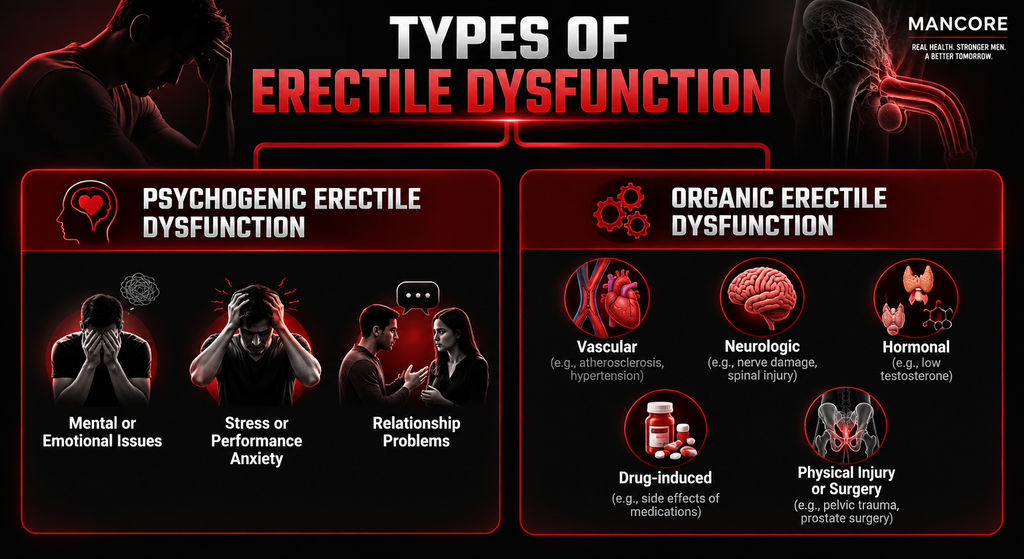
Psychogenic ED: When Your Mind Takes Over
Psychogenic ED starts in your head. Stress, anxiety, depression and relationship problems are the usual triggers.
The symptoms often hit suddenly. You might notice low libido. You may still get firm morning erections or solid erections when you’re alone. That’s a classic clue that your body works fine.
Most men with this type get trapped in a cycle. Think of it as trauma re-enactment anxiety. Here’s how it works:
- Stress ruins an intimate moment once.
- Your brain stores that memory.
- Next time, it predicts the same failure.
- You start watching yourself instead of enjoying the moment.
- That fear releases stress hormones like cortisol.
- Your body tenses up, and the erection fades.
Now the prediction comes true. Your brain files that away too. The loop tightens. Over time, the stress spills into your daily life and drains your energy.
Organic ED: When Your Body Is the Cause
Organic ED has a physical cause. In this type, you feel desire. But you can’t get a proper erection, or you can’t keep one.
Many men then pretend they have low desire. They want to avoid embarrassment in front of a partner. That silence hurts both people.
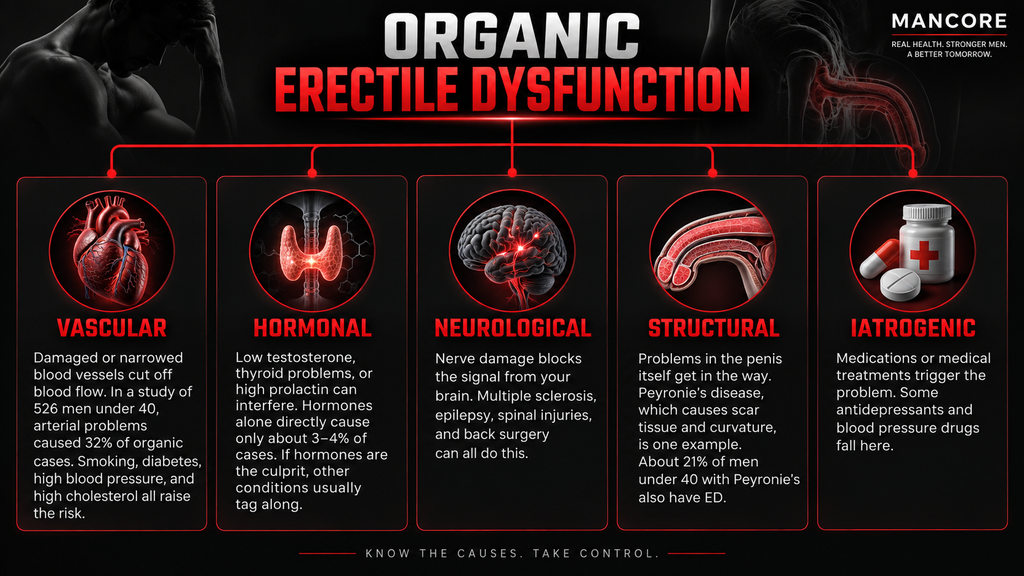
Doctors group the physical causes into five categories:
Erection-Killing Mistakes Young Men Make
A lot of doctors hear a young man complain about erections and assume it’s all in his head. Others blame porn or too much masturbation.
But the research points elsewhere. One study of 100 men under 40 found that only 13% had purely psychogenic ED. That means about 87% had an organic component too.
So what’s going wrong? Often, it’s everyday habits.
Extra weight and no exercise. Belly fat disrupts your hormones and strains your blood vessels. Weight gain lowers testosterone. Weight loss raises it, and the effect is even stronger in younger men. Sitting all day also slows your circulation. Weak circulation means weaker erections.
Sugar, greasy food and constant stress. Too much sugar in the diet can increase risk of diabetes, which can harm nerves and blood vessels. Diabetes is among the greatest risk factors for ED. The foods that increase cholesterol clog your arteries early on. Studies of young males with ED showed elevated cholesterol, triglycerides and blood pressure levels even though they appeared normal.
None of these mistakes feels serious at 25. But your blood vessels keep score.
When ED Is a Warning Sign for Your Heart
Here’s something many young men don’t realize: erectile dysfunction can sometimes be an early warning sign of cardiovascular problems. The arteries in the penis are smaller than those in your heart, so problems with blood flow may become noticeable there earlier. In some studies, ED has appeared about three years before cardiovascular events, with the association being particularly important in younger men. Erections and ejaculation involve different processes, so being able to climax doesn’t necessarily mean blood flow is optimal.
If erections are consistently weak or only partial, including during masturbation, it’s worth discussing with a doctor rather than assuming it’s just performance anxiety. Persistent ED can have many causes, but checking basic cardiovascular risk factors such as blood pressure, cholesterol, and blood sugar can help uncover problems that might otherwise go unnoticed.
Can Antidepressants (SSRIs) or Oral Delay Medicines Cause ED?
Many young men take SSRIs for anxiety or depression. Some also use them off-label to delay ejaculation. These drugs help many people. But they can hurt your sex life.
SSRIs commonly cause low desire and delayed ejaculation. Erection problems show up often too. Some SSRIs, paroxetine in particular, can block nitric oxide, the chemical your body needs to widen blood vessels. They can also raise prolactin and dampen your hormone signals.
Over time, some men feel tired and flat. Their libido stays low. Then the worry about sex adds a psychological layer on top.
Don’t Dismiss It, Don’t Panic
Research does show that psychogenic ED is common in younger men. They worry about performance, lose confidence and then struggle to keep erections. That anxiety is real, and it’s treatable.
But experts now agree the old split between “mental” and “physical” is too simple. Most cases mix both. A small physical problem can trigger anxiety. Anxiety can then make the physical problem worse.
So if your erection problems keep coming back, don’t write them off as “just in your head.” That belief delays care. It can also hide diabetes, heart disease or low testosterone.
ED is common. It’s treatable. And in many cases, it’s your body’s way of asking for help. Listen to it.
If you’re under 18, talk to a parent, school nurse or doctor you trust. They can guide you without judgment.
Sources:
Leave a Reply