

Why You’re Training Hard but Still Not Building Muscle
You work out 4-5 times per week. You are feeling exhausted during workouts. Your exercises are getting hard. Your muscles are burning and you are sore days later.
But after months, your arms are still the same. You have not yet experienced any changes in your chest. You’ve hit a plateau in your strength. The scale shows no change.
Questions begin to crop up, like – “Why am I not gaining muscle? “Is it all my fault that I’m like this?”
Probably not. Exercising hard and exercising effectively for muscle development are two different things.
The increase in the size of muscles (hypertrophy) relies on multiple factors. It’s possible to work really hard and yet fail to meet one or more of them.
Hard workout ≠ guaranteed muscle growth
Effective stimulus + progressive training + adequate nutrition + recovery + consistency → better conditions for muscle growth.
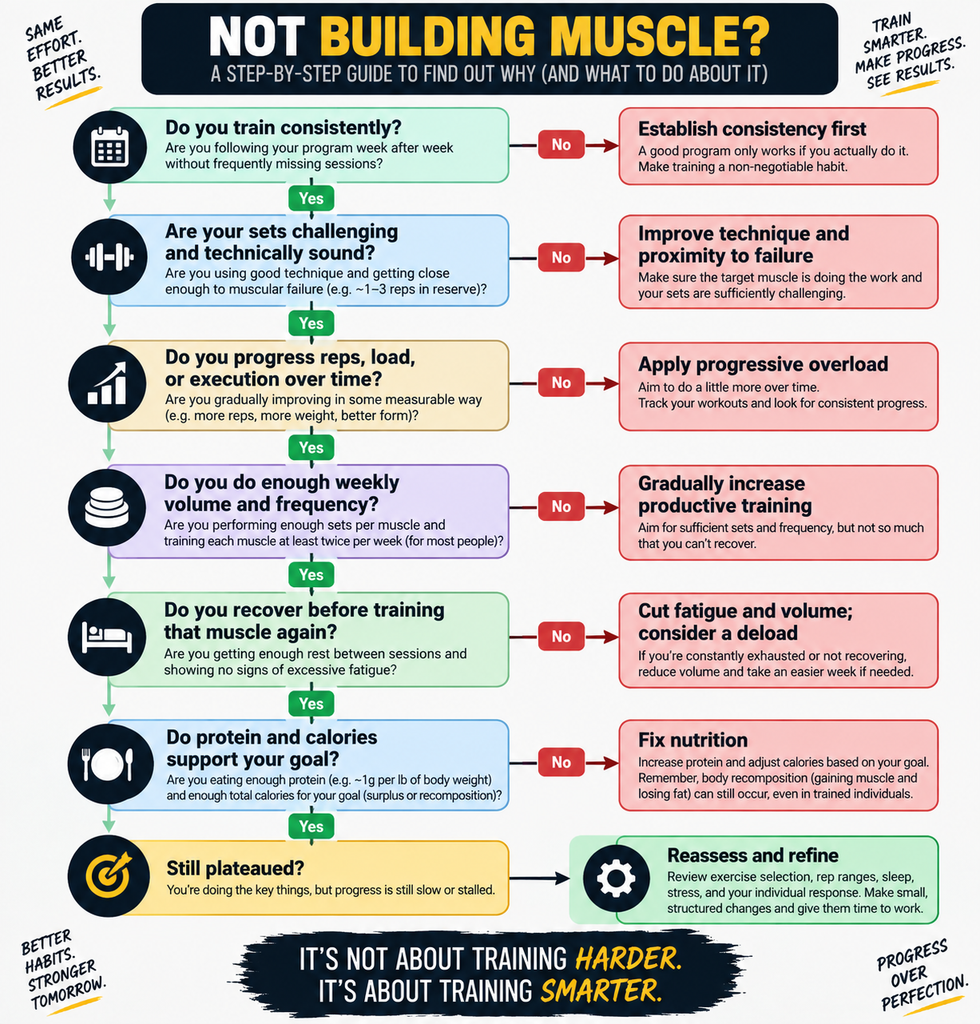
This article helps you find where your process breaks down if you’re not building muscle.
1. You’re Chasing Soreness
Hard training can cause microscopic muscle damage and soreness. But soreness doesn’t prove growth.
Some research suggests that early size increases after damaging exercise can reflect temporary swelling, not true hypertrophy.
Many lifters think, “If I’m not sore tomorrow, I didn’t train hard enough.” That belief pushes them to swap exercises constantly, pile on extra volume, or try to destroy a muscle every session.
Soreness is a possible yet temporary consequence of training, not the objective.
The pump and burn fool lifters in the same way. High reps, supersets, short rests, and drop sets create metabolic stress, and that stress makes a workout feel productive. A pump tells you the muscle worked, but a bigger pump doesn’t automatically mean a bigger hypertrophy stimulus.
Pumps can occur during productive training, so enjoy them. Just don’t use them, or soreness, as your main scoreboard.
2. Your Technique May Train the Wrong Muscles
Don’t ask only, “Did I complete the rep?” Ask, “Which muscle completed the rep?”
A strong mind-muscle connection helps. On many exercises, consciously squeezing the intended muscle helps you execute the movement as planned.
Take the bench press for example. You think you’re training your chest. But sloppy execution can shift the work to your triceps and front delts.
3. You’re Not Pushing Your Limits
You don’t need absolute failure on every set. Get close, and keep your form clean.
Most workouts are focused on finishing within roughly three reps of failure as a troubleshooting benchmark. Later reps feel harder, demand more effort, and often slow down visibly. Those reps tend to challenge the muscle most.
Repetitions in reserve (RIR) estimates how many good reps you could still perform before muscular failure.
4. You Train the Muscle Too Infrequently
Frequency and weekly volume interact. Splitting your sets across two sessions can work well. Adding a second session on top of already high volume can backfire.
“Chest day” once every seven days gives that muscle one stimulus per week.
For a muscle you especially want to grow, the videos recommend training it meaningfully more than once per week. Twice weekly works as a practical starting point.
The pattern looks like this: chest stimulus, recovery, chest stimulus again.
5. You Never Progress
The progressive overload is when the workout feel new every week. However, that shouldn’t be the case, its the stimulus that needs to keep progressing.
Changing exercises constantly to “shock the muscle” makes progress impossible to measure.
Keep useful exercises long enough to track improvement. Progress can mean more reps, more load, better technique, more usable range of motion, or the same work with better control.
A good cycle can count as follows:
- Week 1: 50 kg × 8
- Week 2: 50 kg × 9
- Week 3: 50 kg × 10
- Later: 52.5 kg × 8
6. You Don’t Rest Long Enough Between Sets
There is a myth that resting quite a long between reps can slow the progress down. Whereas, short rests leave you breathless. They also often cost you reps or load on the next set.
Research on shorter versus longer rests points to some guidelines, not rigid rules:
- Most exercises: about 1.5–2+ minutes.
- Demanding compound lifts: around 3 minutes or longer.
Being out of breath isn’t the same as maximizing hypertrophy.
7. Do You Always Need a Calorie Surplus?
If your main goal is maximum muscle gain, sufficient energy matters. But an unchanged scale doesn’t prove you’ve gained nothing.
Barakat et al. (2020) reviewed body recomposition, which means gaining muscle and losing fat at the same time. People often link it to beginners or those with higher body fat. The review found evidence that it can also happen in resistance-trained people.
Don’t assume “the scale isn’t rising, so I can’t be building muscle.” Body weight is one indicator. Fat mass, lean mass, measurements, appearance, and strength can all change differently. Gains in muscle and losses in fat can offset each other on the scale.
8. More Training Can Lead To Less Progress
Muscle grows through a cycle: training stimulus, recovery, adaptation, next stimulus.
Break the recovery step and the cycle turns against you: training, incomplete recovery, more training, accumulated fatigue, lower performance, poorer stimulus.
Watch for these warning signs:
- persistent fatigue
- falling gym performance
- stalled strength
- prolonged soreness
- fading motivation
- workouts that feel like a grind
- working harder while getting weaker
A deload can help. It temporarily cuts training stress so fatigue can fade.
9. Consistency Is the Variable Nobody Can Replace
You can’t evaluate a program you follow sporadically. One excellent workout can’t make up for missed weeks.
Judge progress across weeks and months, not single sessions.
Consistency ties every earlier point together. Good technique used occasionally isn’t enough. Adequate protein occasionally isn’t enough. Progressive overload needs repeated exposure to the same process.
Work down the list. Stop at the first “No.” ↓
Sources:
Leave a Reply