
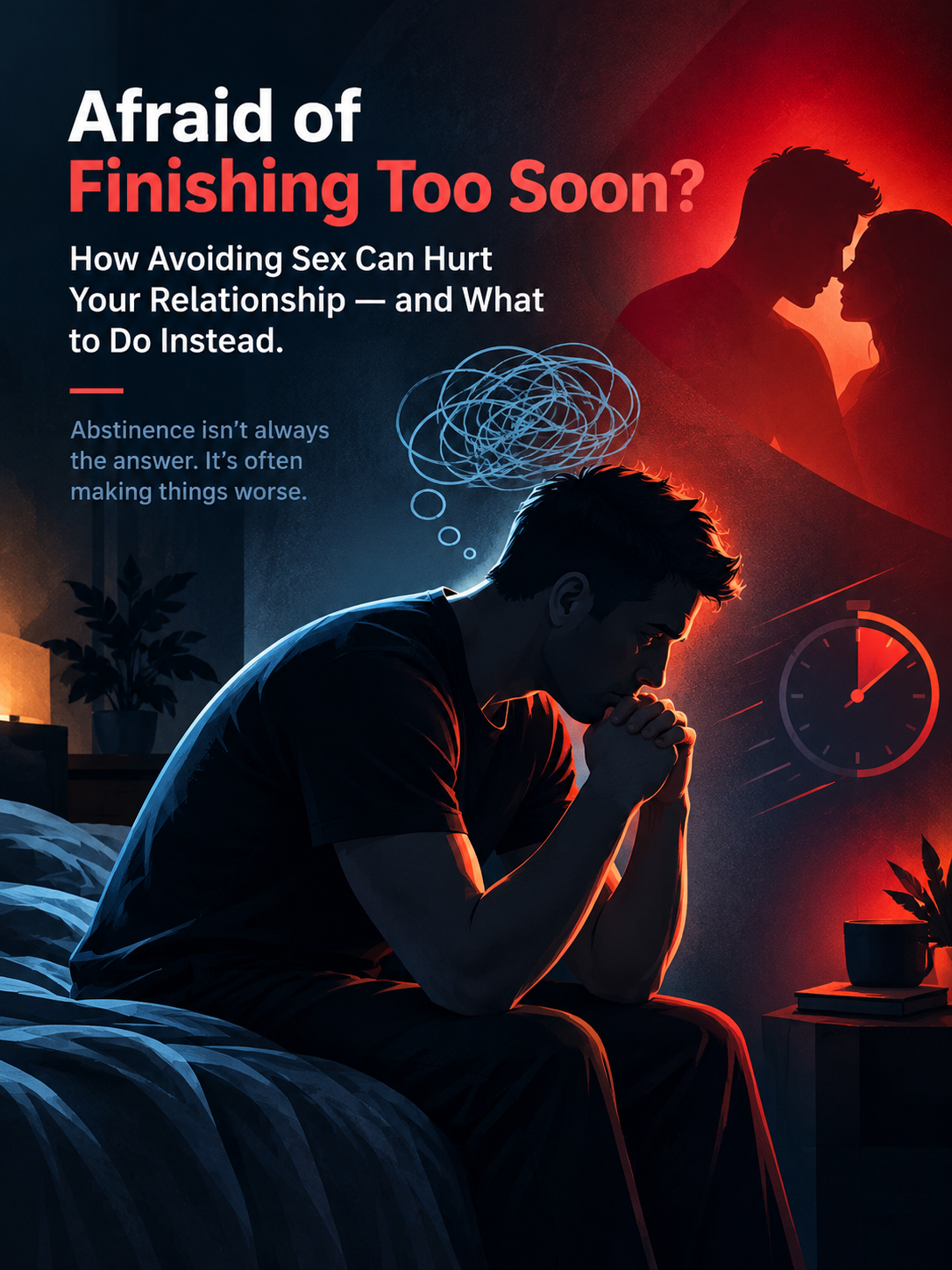
Worried about finishing too soon? You do not have to let that fear control your intimacy.
A practical, compassionate guide to premature ejaculation, confidence, communication, and enjoying intimacy without turning sex into a performance test.
Imagine this: You want to be close to your partner, but a thought keeps getting in the way: “What if I finish too quickly again?”
You may begin avoiding intimacy, making excuses, or waiting for the perfect moment when you feel more confident. The more you worry about what might happen, the harder it can become to relax and enjoy being with your partner.
If this sounds familiar, you are not alone. Premature ejaculation (PE) can cause frustration, embarrassment, anxiety, and relationship strain. But avoiding intimacy is not the only way forward, and you do not have to solve everything in one night.
For some men, the biggest impact of premature ejaculation is not simply ejaculating sooner than they would like. It is the fear that builds around the next sexual encounter. They may start believing that intimacy must last a certain amount of time or that one difficult experience defines their ability to satisfy their partner.
That belief can turn sex into an exam rather than a shared experience. The goal of this guide is to help you understand that cycle and explore practical ways to approach intimacy with less pressure.
1. How Fear of Premature Ejaculation Can Lead to Avoiding Sex
When a sexual experience does not go as expected, it is natural to feel disappointed. The difficulty begins when that disappointment turns into a prediction about every future encounter.
You might start thinking:
- “What if I finish before my partner is satisfied?”
- “What if it happens again and my partner loses interest?”
- “What if my partner thinks something is wrong with me?”
- “It is better to avoid sex than risk feeling embarrassed.”
These worries can increase performance anxiety. Anxiety may make it harder to stay relaxed, notice your level of arousal, and respond calmly when sensations become intense. For some men, this contributes to a cycle of worry and unsatisfying experiences.
However, anxiety is not the only possible cause of PE. Ejaculation control can be influenced by several factors, and persistent or newly developed symptoms may deserve professional assessment.12
2. The Secret Sauce: Stop Treating Sex Like a Test
The goal is not to prove yourself. It is to experience intimacy with greater comfort and connection.
When you judge an encounter only by how long penetration lasts, you may overlook the parts of intimacy that create closeness: communication, touch, affection, pleasure, and feeling comfortable with each other.
Try changing the question. Instead of asking, “How long did I last?” ask, “Was I present? Did we communicate? Did we enjoy being close? Did I feel able to respond when my arousal increased?”
This does not mean ejaculation control is unimportant. It means control is one part of sexual well-being, not the entire measure of your worth or your relationship.
3. Three Practical Ways to Reduce the Pressure
Strategy 1: Take the pressure off penetration
Intimacy does not have to begin with penetration, and it does not have to end with it. Kissing, cuddling, affectionate touch, and other mutually enjoyable forms of intimacy can help you reconnect without making penetration the only goal.
If you are worried about ejaculating quickly, talk with your partner about slowing things down and enjoying other forms of closeness. You can explore what feels good for both of you without treating every moment as a test of your control.
Try this: Agree that your next intimate moment does not have to meet a time target. Focus on comfort, consent, communication, and mutual pleasure.
Strategy 2: Learn to recognise rising arousal
Some men notice that their arousal rises quickly and that they only react when ejaculation feels almost unavoidable. Learning to notice earlier changes in sensation may give you more opportunity to pause or slow down.
One commonly used behavioural approach is the stop-start technique. During stimulation, pause when you feel close to ejaculation, allow the intensity to settle, and resume when you feel comfortable. You can repeat this as appropriate, without forcing yourself to continue through discomfort.23
- Start without a stopwatch or a fixed performance target.
- Notice the sensations that tell you your arousal is increasing.
- Pause before you feel that ejaculation is imminent.
- Relax your body and breathe gently while the intensity settles.
- Resume when comfortable, treating the exercise as practice rather than a pass-or-fail test.
Progress varies. These techniques are not guaranteed cures, and professional support may help if the problem continues to distress you.
Strategy 3: Do not let one encounter decide the next
One difficult experience does not predict exactly what will happen next time. Your stress level, relationship circumstances, arousal, health, and many other factors can differ from one encounter to another.
After a disappointing experience, try to avoid replaying every detail as evidence that you have failed. Instead, consider what you noticed, whether you felt under pressure, and what might help you feel more comfortable next time.
Try this: Replace “I always finish too quickly” with “I have been struggling with this, but I can explore ways to manage it and get help if I need it.” This is not about pretending there is no problem. It is about leaving room for change.
4. Talk to Your Partner Without Turning It Into a Confession
Silence can make sexual worries feel bigger. You may assume your partner is disappointed or judging you, even when you have not discussed how either of you feels.
You do not need to explain everything perfectly. A calm conversation outside the bedroom may be a good place to start.
You could say something like:
“Sometimes I get anxious about finishing sooner than I want to. I care about our intimacy, and I do not want that worry to make me avoid being close to you. I would like us to take the pressure off and work out what feels good for both of us.”
A supportive conversation can help you understand each other’s expectations and reduce the pressure to perform. It can also help you remember that sexual satisfaction is a shared experience, not a responsibility that rests entirely on one person.
- Talk when neither of you feels rushed or upset.
- Use “I feel” statements rather than blaming yourself or your partner.
- Ask what helps each of you feel comfortable and connected.
- Respect each other’s boundaries and consent.
- Consider a qualified psychosexual therapist or counsellor if the issue is creating ongoing distress.
5. What If You Have Tried These Steps and PE Continues?
Premature ejaculation is a recognised sexual-health concern, and it is not simply a failure of willpower. It can be lifelong or develop after a period of previously satisfactory sexual function. Possible contributing factors include psychological, relationship, and physical influences.12
If PE happens frequently, causes significant distress, or has appeared suddenly after previously normal ejaculation control, consider speaking with a qualified healthcare professional. This is particularly important if you also have erection difficulties, pain, urinary symptoms, or other new health changes.
Depending on your situation, a clinician may discuss behavioural approaches, psychosexual support, or medical treatment options. The appropriate choice depends on your history, symptoms, preferences, and potential risks. Do not start prescription medication or unregulated sexual-health products without suitable medical advice.
6. Redefine What a Positive Sexual Experience Looks Like
It is understandable to want more control over ejaculation. At the same time, it can help to stop using a single number of minutes as the definition of a successful sexual experience.
A positive experience may involve feeling less anxious, being able to communicate, enjoying closeness, understanding your arousal better, or feeling more confident about trying again. These are meaningful improvements even if progress is gradual.
There is no universal duration that guarantees satisfaction for every couple. People differ in their preferences, and partners can enjoy intimacy in different ways. If you and your partner are comfortable, connected, and able to talk openly, you are already addressing important parts of sexual well-being.
Final Thoughts: Do Not Let Fear Make the Decision for You
Fear of premature ejaculation can turn intimacy into something to avoid. But you do not have to wait until every worry disappears before you begin working toward a more comfortable relationship with sex.
Start small. Take the pressure off penetration, practise noticing your arousal, communicate honestly with your partner, and give yourself permission to learn gradually. If PE continues to affect your life, qualified professional support is available.
Your worth is not measured in minutes, and one difficult encounter does not define your future. You can take this concern seriously without allowing it to become the whole story of your intimate life.
References
- Serefoglu EC, McMahon CG, Waldinger MD, et al. An evidence-based unified definition of lifelong and acquired premature ejaculation: report of the Second International Society for Sexual Medicine Ad Hoc Committee. The Journal of Sexual Medicine. 2014;11(6):1423–1441.
- Althof SE, McMahon CG, Waldinger MD, et al. An update of the International Society of Sexual Medicine’s guidelines for the diagnosis and treatment of premature ejaculation. The Journal of Sexual Medicine. 2014;11(6):1392–1422.
- Semans JH. Premature ejaculation: a new approach. Southern Medical Journal. 1956;49(4):353–358.
- European Association of Urology. Guidelines on Sexual and Reproductive Health, section on ejaculatory disorders. Read the guideline.
Medical disclaimer: This article is for educational purposes only. It is not a diagnosis or a substitute for personalised medical advice, examination, or treatment. If symptoms persist, change suddenly, or cause significant distress, consult a qualified healthcare professional.
ManCore aims to provide clear, respectful, evidence-informed information to help men make better decisions about their health.
Leave a Reply